BOOK
APPOINTMENT
BOOK 
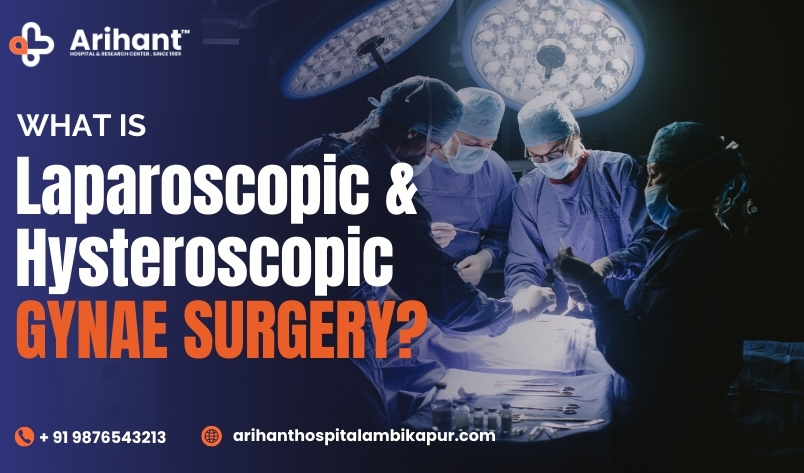
Imagine fixing a delicate piece of jewelry, you wouldn’t use large tools or heavy hands; you’d use precision, light, and care.
In the same way, modern gynecology has evolved. Today, women no longer have to face large incisions or long recoveries for many surgical conditions. With the advancement of Laparoscopic & Hysteroscopic Gynae Surgery, treatment has become gentler, faster, and far more effective.
At Arihant Hospital, Ambikapur, Dr. Ashwin Jain, one of the Best Laparoscopic Surgeons in Ambikapur, brings years of expertise in minimally invasive techniques, helping women recover with less pain, minimal scarring, and quicker return to normal life.
Here, every procedure is performed with precision and compassion, ensuring that your comfort and well-being remain at the heart of care.
Laparoscopic & Hysteroscopic Gynae Surgery refers to modern, minimally invasive surgical techniques used for diagnosing and treating gynecological conditions that affect the uterus, ovaries, or fallopian tubes.
Instead of large cuts, these procedures use small incisions (or sometimes none at all) and high-definition cameras to allow accurate treatment with faster recovery and minimal risk.
At Arihant Hospital, these advanced surgical methods are used for conditions such as fibroids, ovarian cysts, endometriosis, abnormal bleeding, infertility, and uterine disorders.
Laparoscopic surgery, also called “keyhole surgery,” involves making tiny incisions in the abdomen through which a thin camera (laparoscope) and specialized instruments are inserted.
The surgeon views real-time images on a monitor and performs precise procedures without the need for open surgery.
This approach allows our team to treat complex gynecological conditions with great accuracy and minimal discomfort.
Laparoscopic surgery is used in a wide range of treatments, including:
Ovarian cyst removal (Ovarian Cystectomy)
Laparoscopic hysterectomy (removal of uterus)
Fibroid removal (Myomectomy)
Treatment of Endometriosis
Ectopic pregnancy management
Pelvic adhesiolysis (removal of scar tissue)
Tubal ligation or sterilization
Each of these procedures is done through tiny incisions, often no larger than a buttonhole, resulting in less pain and quicker healing.
A small incision is made near the belly button.
The abdomen is filled with carbon dioxide gas to create space for visibility.
A thin laparoscope with a light and camera is inserted.
Surgical tools are guided through additional small incisions to complete the procedure.
The instruments are removed, and stitches are applied using fine sutures.
Most laparoscopic procedures are completed within 1–2 hours, and patients can return home within 24–48 hours, depending on the case.
Uterine fibroids causing heavy bleeding or pain
Ovarian cysts or tumors
Ectopic pregnancy
Removal of uterus (laparoscopic hysterectomy) for medical reasons
Laparoscopy offers superior visualization and precision, which significantly reduces surgical risks and improves outcomes.
While laparoscopy treats problems outside or around the uterus, hysteroscopic surgery focuses on the inside. It involves inserting a thin, lighted camera (hysteroscope) through the vagina and cervix to view and treat the uterine cavity, without any external incision.
This procedure allows us to diagnose and treat uterine conditions with exceptional accuracy while maintaining comfort and fertility.
Hysteroscopic surgery is commonly used for:
Polyp or fibroid removal (Hysteroscopic Myomectomy)
Uterine septum correction (congenital defects)
Endometrial biopsy and sampling
Removal of intrauterine adhesions (Asherman’s Syndrome)
Treatment of abnormal uterine bleeding
Evaluation of infertility or repeated miscarriages
These procedures are usually performed as day-care surgeries, allowing patients to return home the same day.
A hysteroscope (a small camera) is gently passed through the cervix.
The uterus is expanded with saline for a clear view.
Using fine instruments, the doctor removes or corrects abnormal tissue.
No incisions, no stitches, minimal pain and faster recovery.
Heavy or irregular menstrual bleeding
Uterine fibroids and polyps
Unexplained infertility
Removal of foreign bodies (e.g., retained IUD)
Structural uterine problems affecting conception
Hysteroscopy provides a safe, scar-free solution for many gynecological problems that once required major surgery.
These advantages make Laparoscopic & Hysteroscopic Gynae Surgery the preferred approach for modern women’s healthcare.
The cost of Laparoscopic & Hysteroscopic Gynae Surgery in Ambikapur varies based on the type and complexity of the procedure.
Factors affecting the cost include:
At Arihant Hospital, the pricing is transparent and discussed clearly before treatment.
Patients receive detailed estimates and post-operative care guidance to ensure clarity and comfort throughout their surgical journey.
Post-surgical recovery is usually quick.
At Arihant Hospital, special attention is given to pain management, wound care, and counseling to ensure stress-free healing.
Women’s health deserves precision and compassion, and that’s exactly what modern gynecological surgery offers.
At Arihant Hospital, Ambikapur, our team blends advanced medical expertise with genuine care through safe and effective Laparoscopic & Hysteroscopic Gynae Surgery.
“Modern surgery isn’t about bigger cuts, it’s about smaller scars and stronger recoveries.”
Book your consultation today to explore minimally invasive options for fibroids, cysts, or other gynecological concerns, and take a confident step toward better health.
Laparoscopy can treat fibroids, ovarian cysts, endometriosis, infertility, and ectopic pregnancy. It’s a safe and precise alternative to open surgery with faster recovery.
No. Hysteroscopic procedures are done under mild anesthesia and cause minimal discomfort. Most patients return home the same day with very short recovery time.
Most women resume normal activity within 7–10 days. Light work can be started earlier, depending on the type of procedure and individual recovery speed.
Yes, with proper pre-operative evaluation and monitoring, these procedures are safe even for older patients. Minimal blood loss and smaller incisions make recovery easier.
If you have persistent pelvic pain, abnormal bleeding, fibroids, or cysts not improving with medication, consulting a Laparoscopic & Hysteroscopic Gynae Surgery specialist is recommended for accurate diagnosis and effective treatment.
This information is intended for educational and informational purposes only and should not replace medical advice.